

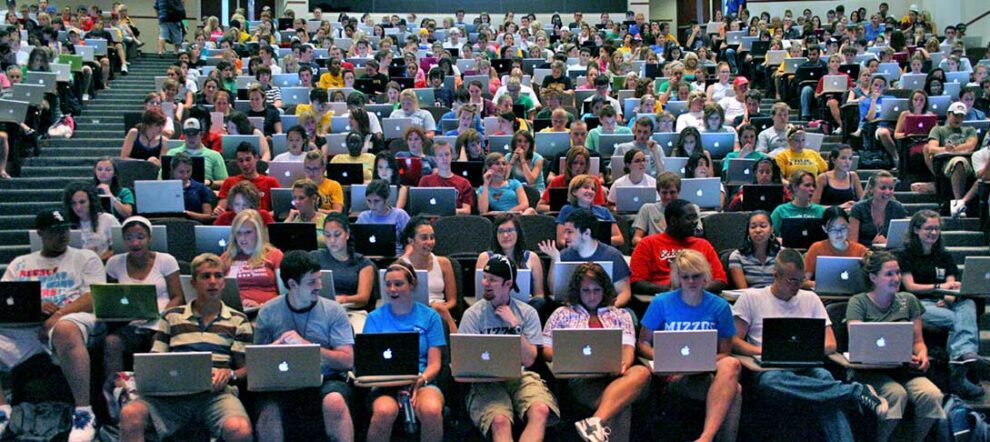
Professors are pushing back against the distraction laptops pose for students in the classroom.
A growing number of professors across the country are banning laptops and cell phones in their classrooms. Professors have witnessed firsthand the distractions caused by technology in a learning environment.
Jody Hey, a biology professor at Temple University who has taught for more than 12 years, banned laptops in the classroom over a year ago after seeing research that his students are often distracted with the devices open in front of them. The research showed that students learn better when they take handwritten notes.
“The clearest sign that it’s making a difference is that students are paying attention more, and they want to participate much more than before,” said Hey in a recent interview.
“At first I didn’t like it because I kind of organize all my notes on my laptop. But I feel I’ve been learning better by writing my notes,” said Jess Nguyen, a junior genomic medicine major in Hey’s class.
“After a couple classes, you kind of get used to it,” said Sara Tedla, a natural sciences major.
“It’s good that for an hour and 20 minutes you can just sit down and, without any technological distractions, focus because that’s a part of your brain you can work on, said Quinn Johnson, a senior ecology major from Philadelphia. The more you do it, the easier it becomes to focus on something for a long period of time.”
Jessa Lingel, an associate professor of communication at the University of Pennsylvania, had teaching assistants observe students’ laptops from the back of her classroom to see what they were using the devices for during class.
Students “were out there booking flights and Airbnbs,” said Lingel. “Fun fall cocktail recipes. They were online gambling in class. I thought, ‘This is not acceptable.’”
“It’s a movement,” she said. “More and more people are headed in this direction.”
Hey conducted research on the topic and presented it at a Temple department faculty meeting earlier in the year.
“As early as 2003, a study was done contrasting the retention of lecture material by two groups of students, one who had laptops and unrestrained internet access and a second who worked without laptops. In that study, students with laptops scored 20% lower on average in the subsequent exam,” Hey said.
Another study revealed that four out of every five students who used laptops in a general psychology class said they checked emails during lectures. The study showed that 68% used instant messaging, 43% surfed the net, 25% played games, and 35% said they did “other” activities.
Additional research shows that students who took notes by hand perform better on exams. This research is influencing more and more professors to kick laptops out of the classroom.